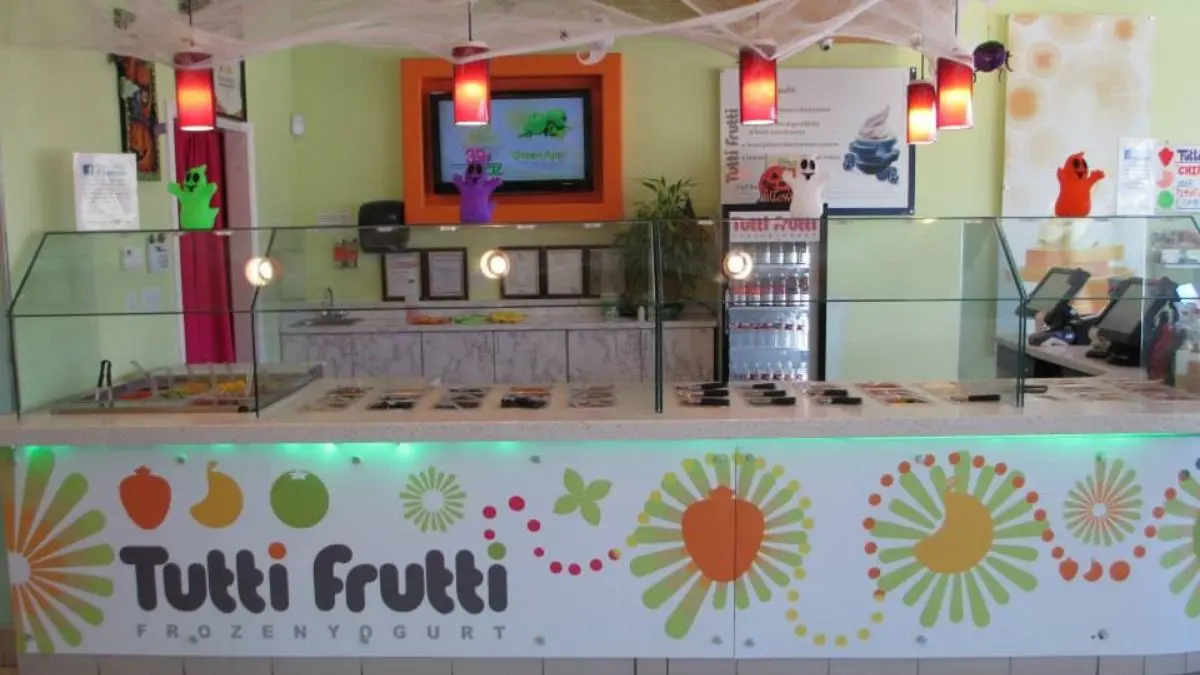
Tutti Frutti is a self-serve frozen yogurt franchise with a soy-based line and a range of fruit sorbets. If you have found this page looking for a current flavour list, there is something you need to know first.
Answer: Tutti Frutti’s websites are broken, but the brand does still serve one document, and it is more useful than an earlier version of this page allowed. A per-flavour nutrition sheet is live right now at tfyogurt.ca — it carries an explicit allergen statement and it categorises 31 products on non-dairy bases: sorbet made with water, sorbet made with juice, and soy made with water. What it does not do is say the word “vegan” anywhere, or publish a single ingredient list. And it is stamped “UPDATED 9/19/13”.
Correction, 1 August 2026
An earlier version of this page framed Tutti Frutti as a brand that tells you nothing — that its website is gone and there is no current data to be had. The first half is true. The second half was too strong, and we are correcting it.
The nutrition sheet is not an artefact recovered from an archive. It is being served by the brand’s own domain, at HTTP 200, today. Re-checked on 31 July 2026:
https://tfyogurt.ca/downloads/TF_nutritionsheet.pdf— HTTP 200, 180,193 bytes,content-type: application/pdf, serverLast-Modified: Thu, 08 Oct 2015. Three pages, every page stamped “UPDATED 9/19/13”.
Why it was nearly missed is worth stating, because it is the same trap for anyone else looking: the file is orphaned. It is not in the site’s sitemap. The directory it sits in, /downloads/, returns HTTP 403. And every HTML page on the site returns HTTP 500, so no working page links to it. Nothing crawls to this file and no search of the site’s text will surface it. It was reached by guessing the path. A dead content management system does not mean dead static files — the PHP is broken, the web server is still handing out the PDFs sitting behind it.
So the honest position is not “Tutti Frutti tells you nothing.” It is: Tutti Frutti has one reachable document, it contains real allergen and product-category information, and it is thirteen years old.
The brand has no working website
Checked from two independent locations on 31 July 2026:
- tfyogurt.com — the old US corporate domain — publishes no A or AAAA record. Queried against Google’s public DNS from a workstation and independently with
digfrom a server on a different network, both return nothing fortfyogurt.comandwww.tfyogurt.com. Nameservers exist, so the domain is delegated, but there is no address behind it. There is no website to fetch. - tfyogurt.ca — resolves, but every HTML route returns HTTP 500, a WordPress fatal error. Confirmed by plain request, from a second network, and through a full browser session. This is a genuine server-side failure, not a block. The static file path is the only thing still working.
- Other domains bearing the name are either parked, a single independent café in California, an unrelated organisation, or an independent blog that explicitly disclaims any connection: “Tutti Frutti Frozen Yogurt is an independent blog… We are not affiliated with or sponsored by Tutti Frutti Frozen Yogurt or its franchise partners.” None of them counts as a brand source, and none is cited here — including the one that some reference works still list as the brand’s official site. It is not.
What the sheet says about allergens
Verbatim, and it is the whole of it:
“* No Sugar Added
**Allergen Information: Our yogurt is processed in a facility that processes wheat, soy, dairy, tree nuts, and peanuts.“
That is a facility cross-contact line. It is a real allergen statement from the brand, and it is worth having — but it is not an ingredient statement and it is not a vegan designation. The word “vegan” does not appear on the sheet at all.
Read plainly, it says the same equipment environment handles dairy, wheat, soy, tree nuts and peanuts. If you are avoiding dairy for medical reasons, that sentence is the single most important thing on this page. If you are avoiding it for ethical reasons, it does not settle anything on its own, because it describes the facility rather than the recipe.
31 products on non-dairy bases — and what that does and does not prove
The sheet sorts every product into a base, and three of those bases are not milk. Read cell by cell from a rendered image of page 3 rather than by text extraction:
“SORBET WITH WATER” (14): Blueberry · Kiwi · Lemon · Lychee · Mango Pineapple Sorbet · Orange Pineapple Sorbet · Passion Fruit · Peach · Pink Lemonade · Pomegranate · Raspberry · Strawberry · Tuti Frutti Sorbet · Yacoo
“SORBET WITH JUICE” (7): Grape Sorbet · Green Apple Sorbet · Mango Sorbet · Energy Sorbet · Pineapple Sorbet · Strawberry Apple Sorbet · Tropical Sorbet
“SOY WITH WATER” (10): Soy with water · Almond Soy · Black Sesame Soy · P-nut Butter Banana Sandwich · Peanut Butter Soy · Soy Banana Milk · Soy + Plus · Soy Red Bean · Soy Latte · Soy Taro
Now the caveats, and they are not small ones.
- A base is not an ingredient list. “Sorbet with water” tells you what the product is built on. It does not tell you what else went into it. The live sheet publishes no ingredient lists at all — not for one product. A flavour powder stirred into a water base can still carry a milk-derived ingredient, and nothing in this document would show it.
- Do not read the cholesterol column as a dairy test. Every sorbet and soy row shows 0 mg cholesterol. So do most of the milk rows. Milk proteins such as casein carry essentially no cholesterol, so a zero there rules out nothing.
- The same flavour name appears under more than one base. Eleven names sit in both the milk band and the water-sorbet band, spelled identically: Blueberry, Kiwi, Lemon, Lychee, Passion Fruit, Peach, Pink Lemonade, Pomegranate, Raspberry, Strawberry and Yacoo. Several more differ only by a suffix — Mango and Mango Sorbet, Grape and Grape Sorbet, Taro and Soy Taro, Red Bean and Soy Red Bean. A flavour name alone tells you nothing. Only the section band does — and the machine in the shop is labelled with the name, not the band.
- Thirteen years. The content is dated 9/19/13 and the file has not been touched on the server since 2015. Recipes change. This proves what the groupings were then.
The document is an extract, and it is the wrong region
Two things about this file that a reader should know before leaning on it:
- It is a three-page extract of a longer document. The page numbers printed in the footers are 1, 2 and 6. Pages 3, 4 and 5 — and anything after 6 — are not in the file being served. Whatever they contained, including any further footnotes, is not available.
- It is the US “out of state” edition, sitting on the Canadian domain. Every page is headed “OUT OF STATE”. There is no Canadian edition on the Canadian site.
Corrections: what this page got wrong
- Two flavours were described as “Allergen-free” — Cookies N Cream and Spiced Cake. This was the most dangerous pair of words on the page, because it would be read by someone avoiding dairy for medical reasons. Nothing at Tutti Frutti is allergen-free. The brand’s own line is above: the facility processes wheat, soy, dairy, tree nuts and peanuts. Both claims have been deleted.
- “Cookies N Cream — a soy froyo.” On the 2013 sheet, Cookies N Cream appears under “WITH 2% MILK AND CREAM”, not under the soy section.
- “Sadly, soy almond, coconut, and taro contain dairy.” Contradicted for two of the three. On the 2013 sheet, Almond Soy and Soy Taro both sit in the “SOY WITH WATER” band, not the milk bands. A separate Coconut does appear under the milk pages, so that third of the claim is consistent.
- “The pink lemonade sorbet is the only one so far that contains dairy.” Contradicted — but read the base caveat above, because this is the trap on this document. Pink Lemonade sits in the “SORBET WITH WATER” band. A separate PINK LEMONADE row also appears on the milk page. The same flavour name exists in both a milk and a water formulation, which is exactly why the claim cannot be made without naming which one.
- Eight of the sixteen “soy” flavours are not in the soy section of the only brand document available: Banana, Candy Cane Cookies N Cream, Cookies N Cream, Chai Tea, Cocoa, Melon, Spiced Cake and Strawberry. Two flavours that are in it — Almond Soy and Soy Taro — the page listed as containing dairy.
- Eight of the twenty-three sorbets are not on the sheet at all: Cherry Cola, Gummy Bear, Jingle Jangle Holiday Punch, Lemonade Iced Tea, Orange Summer Burst, Spiced Autumn Punch, Strawberry Lemonade and Watermelon. Four that are on it were missing from the page: Energy Sorbet, Mango Pineapple Sorbet, Pink Lemonade and Tuti Frutti Sorbet.
- Every per-flavour health claim — “Non-dairy, non-fat, and protein-enriched”, “Contains gluten”, “fat-free”, “less fat and more protein”, “no tartness” — has been deleted. The sheet publishes numbers but no ingredient lists and no per-flavour gluten declaration, so there was never a source for any of them.
- “Over 700 locations spread across 30 countries”, “the largest self-serve frozen yogurt chain on Earth”, “began in 2011 in Edmonton, Canada” and “125 flavors” — all removed. None is sourceable, because the brand has no working website to source it from. (The sheet lists roughly 100 rows across all bases, not 125.)
- “They do have an abundance of vegan options” and “Tutti Frutti definitely holds up as one of the best vegan-friendly froyo shops” — removed. Tutti Frutti has never used the word “vegan” in any document obtainable on 31 July 2026.
- And this page’s own over-correction, noted above: framing the brand as publishing nothing usable. It publishes one document, it is live, and it is described properly here now.
Three sections recommending other froyo chains (TCBY, Kiwi Yogurt, Pinkberry), with specific flavour claims for each, have also been removed. None was sourced, and one rested on a link from 2013.
The rest of the sheet
Pages 1 and 2 are the milk-based flavours, under “WITH 2% MILK AND TART” (about 40 flavours) and “WITH 2% MILK AND CREAM” (about 35), plus small bands for “WITH 2% MILK & VANILLA / & CHOCOLATE / & COFFEE / & RED VELVET / & NSA / & SALTED CARAMEL”. They include Cookies N Cream, Green Tea, Coconut, Taro, Red Bean, Peanut Butter, Mint, Guava, Papaya and Pina Colada — all names that also appear on the non-dairy pages.
The numeric columns, read from the rendered pages, are: Quantity, Calories per 28g, Calories %DV, Calories from Fat, Protein, Carbohydrates (g), Carbohydrates (%DV), Fiber, Sugar, Fat (g), Fat (%DV), Saturated Fat, Trans Fat, Cholesterol, Vitamin A, Vitamin C, Calcium, Iron, Sodium. Per-flavour values are not reproduced here: the headers are printed rotated ninety degrees, they fragment on text extraction, and the useful question on this page is what is in the product, which no column answers.
Stores are independently owned, and stock differs
Even if the 2013 groupings still held, they would not tell you what is in the freezer near you. Tutti Frutti stores are independently owned and stock varies by territory.
One live master-franchise territory — Western Australia — currently publishes, verbatim: “WE ARE NOT DOING ANY SOY FLAVOURS AT THE MOMENT.” The entire soy line this page was built around is not stocked there at all. That is one territory’s statement, not the brand’s, but it is enough to sink the old page’s framing that you can “always hope and count on finding a Tutti Frutti parlor near you” with these flavours.
The same franchisee publishes a nutrition disclaimer worth quoting in full, again as one territory’s statement rather than the brand’s:
“…we have been unable to import all required products from our parent distributor company Tutti Frutti (Wellspring, USA) and in specific cases have to utilise alternatively approved local Australian products to make yogurt at our stores. We cannot guarantee if the Nutritional Values given below are actually correct for alternate products used in specific cases… If you have any allergies or specific Nutritional requirements then we recommend you do not consume our products. The chart is INDICATIVE ONLY.”
Where that leaves you
Tutti Frutti does publish something, and it is worth knowing: an allergen facility statement, and a product list in which 31 items are built on water, juice or soy rather than milk. What it has never published is an ingredient list, a vegan designation, or anything at all since 2013.
If you are avoiding dairy for ethical reasons, the sorbet and soy lines are the ones to ask about — ask by base, not by flavour name, because the names repeat across bases. Look at the machine labels, and treat the 2013 groupings as history rather than fact. If you are avoiding dairy for medical reasons, the brand’s own facility statement and that franchisee disclaimer are the two things to weigh, and they both point the same way.
If tfyogurt.ca ever recovers — its error is a software fault, not a takedown — its per-flavour pages would be the place to look. tfyogurt.com will not come back without a DNS change.
Sources
All checked 31 July 2026: DNS lookups for tfyogurt.com and www.tfyogurt.com from two independent networks; HTTP requests to tfyogurt.ca from three routes including a full browser (root, /about/ and every other HTML path: HTTP 500; /downloads/: HTTP 403); and TF_nutritionsheet.pdf — re-fetched at HTTP 200, 180,193 bytes, server Last-Modified 8 October 2015, three pages with footers 1, 2 and 6, every page headed “OUT OF STATE” and stamped “UPDATED 9/19/13” — rendered to images at 170 dpi and read visually rather than text-extracted. The Western Australia master-franchise site is used only where it is explicitly labelled as one territory’s own statement. No vegan blog, listicle, aggregator or archive was used as evidence, and the independent blog that ranks for this brand was excluded because it disclaims any affiliation with it.