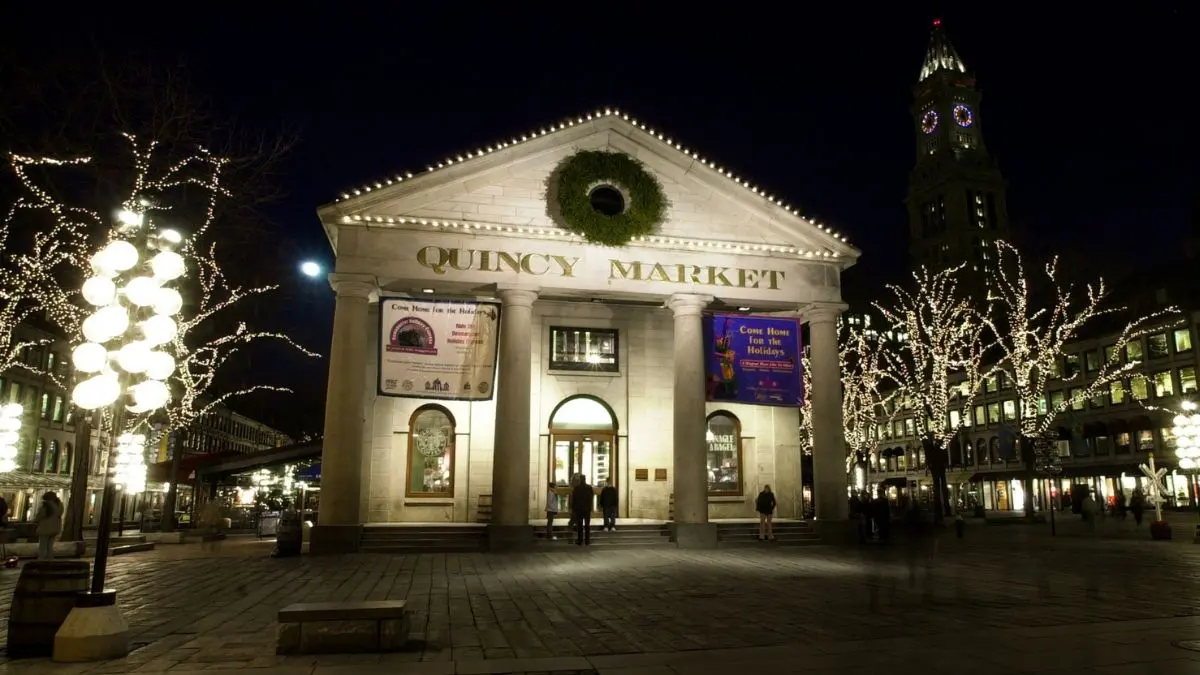
Quincy Market sits in the middle of Boston’s Faneuil Hall Marketplace, and its Colonnade — the long central hall lined with counters — is described by the marketplace itself as the first food hall in the United States. That is the single most important fact for anyone reading this page: Quincy Market is not a restaurant. It is a building full of separate businesses.
Answer: it depends entirely on which counter you walk up to, and nobody can tell you in advance. Quincy Market has no menu, no kitchen and no allergen policy of its own — it is a landlord with roughly two dozen independently operated stalls inside it. The marketplace’s official directory lists what each vendor sells in about eight words and publishes no ingredients and no allergen information for any of them. That means nothing at Quincy Market can be confirmed vegan from an official source, and any article that gives you a confident list is guessing.
This page used to be one of those articles, so a correction comes first.
Most Of What This Page Recommended No Longer Exists
The earlier version of this article listed thirteen specific dishes. Six of them came from Wagamama, three from Gourmet India, and one from a Sprinkles Ice Cream and Fudge Shoppe. None of those three businesses appears anywhere in the Faneuil Hall Marketplace dining directory as of 28 July 2026 — not in the Quincy Market Colonnade and not in the wider marketplace directory of 35 food and drink tenants.
So ten of the thirteen recommendations were for food you cannot buy at Quincy Market. Detailed ingredient lists were given for several of them. They have all been removed.
Two of the vendors named do still trade there: Steve’s Greek Cuisine and Ueno Sushi. More on both below, though not in the form the old article used.
Why There Is No Allergen Source For Quincy Market
Because there is no such thing as Quincy Market food. The Colonnade currently houses 27 listed vendors, each an independent operator with its own suppliers, its own recipes and its own staff. A stall can change hands, change its menu, or leave, without any announcement.
The marketplace’s own website is a directory, not a menu. Steve’s Greek Cuisine gets the line “Greek inspired dinner, salads and wraps.” Ueno Sushi gets “Fresh sushi and sashimi plus a variety of Japanese dishes.” Green Organic Bowl gets “Salads made fresh to order!” That is the entire published record. There is no ingredient statement, no allergen chart and no cross-contact policy anywhere on the site, for any tenant.
This is not a criticism of the marketplace so much as a description of what a food hall is. But it does mean that anyone claiming to know what is in a Quincy Market dish, without having asked that specific counter on that specific day, is making it up.
What Is Actually In The Colonnade Right Now
As listed by the marketplace on 28 July 2026: Bakey Babka, The Berry Twist, Boston & Maine Fish Company, The Boston Chipyard, Boston Chowda, Boston Scoops, DalMoros Fresh Pasta To Go, The Dog House, El Paso Enchiladas, Green Organic Bowl, Jen Lai, Joey’s Gelateria, KongDog, Megumi, mmMac N Cheese, Monkey Bar, Naughty Waffle, North End Bakery, Oyster Bar, Pokeworks, Prime Shoppe, Regina Pizzeria, Steve’s Greek Cuisine, Ueno Sushi, Vivi Bubble Tea, West End Strollers and Wicked Lobsta.
That list is the honest version of this article. A vegan reading it can see immediately which counters are worth approaching — the salad, Greek, Japanese, Mexican, Chinese, pizza and poke stalls — and which are lobster rolls, chowder, hot dogs and gelato. What none of us can do is tell you what is in the food before you ask.
One exception is worth knowing about. Pokeworks is a national chain rather than a one-off stall, and unlike its neighbours it publishes allergen and nutrition information centrally on its own website, along with a cross-contact warning stating that it “cannot guarantee the complete absence of allergens.” If you want documentation before you order, that is the only counter in the Colonnade that offers any. We cover it separately in our guide to vegan options at Pokeworks.
Steve’s Greek Cuisine And Ueno Sushi
These are the two vendors from the old article still in the directory, and the temptation is to carry the old recommendations across. We are not going to, because neither business publishes anything to support them.
At a Greek counter, the questions that decide whether a wrap or a plate is vegan are narrow and worth asking directly: is there yoghurt or feta in the sauce, is the pita brushed with butter or dairy on the grill, are the falafel and any fried items cooked in oil shared with meat or cheese, and are the grape leaves prepared with meat. “Is this vegan?” gets a vaguer answer at a busy counter than any one of those.
At a sushi counter, the specific unknowns are different. Sushi rice is commonly seasoned, and the seasoning is where sugar and other additions live. Miso soup is built on a broth, and the standard broth is dashi, which is frequently made with bonito — dried fish — so “the miso paste is vegan” does not settle the question of the soup, which is what the earlier version of this page claimed. And a vegetable roll made on the same board, with the same knife and the same gloved hands as the fish is a cross-contact question the counter can answer and we cannot.
None of that means the food is not vegan. It means it is unverified, and the honest place to resolve it is at the counter, before you pay.
How To Eat Here As A Vegan
Walk the Colonnade first, and treat it as reconnaissance rather than lunch. It is one long hall, so you can read every board in ten minutes before committing.
Ask about one thing at a time. Dairy in the sauce, egg in the dough or dressing, shared fryer, shared grill. Counter staff answer specific questions far more reliably than general ones, and at a food hall you are usually talking to someone who works that station.
Expect the answer to change. Vendors in the Colonnade turn over; three of the businesses this article was originally written around are gone. Anything you read online about a specific stall — including this page — is a snapshot, and a food hall is the format where snapshots go stale fastest.
Quincy Market — The History
Per the marketplace’s own history page, Faneuil Hall was built in 1742 as a gift to Boston from the merchant Peter Faneuil — the site notes that a significant portion of his wealth came directly and indirectly from human enslavement. Quincy Market was added in 1826 as the city outgrew the original hall, named for Mayor Josiah Quincy, who organised its construction without tax or debt; the North and South Market buildings followed in 1827.
By the mid-1900s the buildings were derelict and slated for demolition. The 1976 restoration, driven by developer Jim Rouse, architect Benjamin Thompson and Mayor Kevin White, became the original “festival marketplace” and the model that was copied across the country. Today the marketplace holds over 80 retailers across more than 200,000 square feet.
An earlier version of this article dated Quincy Market to 1825 and gave an eatery count sourced to a third-party website. The marketplace’s own pages give 1826 and a current directory, so both have been corrected.
Wrapping Up
Quincy Market is a good place to be a vegan in the sense that a hall with 27 counters will have something for you. It is a bad place to be a vegan who wants certainty, because not one of those counters publishes what is in its food.
The previous version of this page papered over that with a list of dishes, most of which no longer exist. What is left is less satisfying and considerably more useful: go, look at the boards, ask about dairy, egg and shared equipment at the counter that appeals, and do not trust any list — ours included — that claims to know what a Boston food stall put in its sauce this week.